Due to my exceptional powers persuasion and general awesomeness, I was one of a lucky few airmen selected to participate in the Hyundai Motor's Cultural Friendship Tour (actually, I just happened to be the only new guy in the shop who showed any interest in Korean culture, but hey, allow me my fantasies). In order to promote good continuing relations between our countries, Hyundai sponsors these three day trips twice a year for about 120 service members each. In that short period we travel to both ends of the peninsula, visit industrial, historical, artistic, religious and military points of interest, as well as are educated on Korean culture throughout the ride. Needless to say, this was right up my alley and I am still thinking of the best way to appropriately thank my supervisor for getting me on this trip!!
It all started in Seoul, well, actually in Songtan for me, as it is an hour bus ride to Seoul, specifically Youngsan Army Base, where we were gathering. Anyways, once there we were briefed on what was expected of us and the general itinerary. As it happened, they basically just wanted us to be polite, pay attention, take lots of pictures and eat Korean food. Daunting as these tasks may be, I was resolved to do whatever it took to impress, even if that meant I had to order seconds or thirds! LOL The group of about 100 was divided into six buses, each assigned its own tour guide. As a member of Bus 6 I was introduced to our super-high-tech and very comfortable bus, insanely masterful driver, and beautiful and gracious tour guide Ms. Linn. Introductions complete, and cheeks comfortably situated, the caravan disembarked starting our five hour drive to Ulsan City and the main production site of Hyundai Motors.
Along the way we stopped twice at rest stations on the Korean highway, and I was very impressed with the facilities there. The stations seemed to be semi-standardized, with large restroom accomodations, a cafateria, several fast food vendors and the ubiquitous snack carts. Everything was clean, but at every stop we were swarmed by children on school trips. Now, I know everyone is used to me being a paragon of patience and cultural understanding...however, the shear number of children and the inherent chaos they bring was almost too much for me to bear. So, rest stops were made with the utmost of haste on my part, lest I get swept away in a tide of grumpy-old-man outrage....
On a more pleasant note, we ate lunch at one of the cafeterias and I had some not-so-special Bipimbop (basically steamed rice with various "stuff" added) which was actually quite tastey and filling, as well as a simple squid salad. Of more interest was a side dish of unpeeled root vegetables that looked like miniature parsnips, in a kimchi-like sauce. I asked Ms. Linn about them, but she was not sure how to translate, and so I just have to leave it as a culinary mystery at this point. I am fond of the crunchy and earthy texture they have left in my memory. At about 1330 we arrived in Ulsan city, about 15 minutes behind schedule. This will become important later...
Ulsan city, home to the original Hyundai motor plant, and now home to their Heavy Industries division as well, is a very wealthy city, and it definitely showed. All of the roads were in top condition, the streets were cleaner than I had seen in any other city here, and there was a running trail/park along both sides of the river that meanders through a great portion of the city. Besides being unusually well manicured, this city actually smelled good. To put this into perspective, but not intending to cast any insults at Songtan, the latent aroma of the Songtan Entertainment District (which is the very polite official designation for the trashy bar scene that stretches out before the gates of Osan Airbase) is somewhat of a cross between stale cigarette butts, urine, beer, old frier grease and rotting garbage, with a slight whiff of cologne. Appealing, no? Well, as I tried to explain to a local bartender the last night we were in Ulsan, the air there carried none of those aromas. Sure it had a bit of an industrial scent, but the breeze from the harbor and general cleanliness of the city made it seem like a field full of the Aunts' roses.
Anyways, Ms. Linn informed us that due to the presence of Hyundai and its workers, and those companies sub-contracted out to Hyundai, the average income of the city was nearly double that of the rest of the country. As we took our tour of the facility, we discovered that Hyundai takes very good care of its employees. They are given a generous salary, housing stipend, healthcare, pension, and pay for your first three children to attend college!!! Not too shabby, and as others on my bus said, where do I apply?
Now, as I said, we were running about 15 min late for our tour of the car factory. To be honest, as much as I am a stickler for a schedule, 15 min does not seem like a big deal, but our schedule was jam packed, and could ill afford any errors. Once we arrived, we were ushered into the theater adjacent to the large showroom, introduced to the facility and its capabilities, and shown a promotional video extolling the virtues of Hyundai and its bright future across the globe. I do not doubt any of their claims, and have seem the company grow in the market over the past five years considerably, however, I have to admit that industrial tours are just not my thing. Fortunately for me, our 15min verspaetung meant that our Hyundai appointed tour guide put her high-heels into overdrive and had us through five factory buildings and a complete production life of a car in ten minutes flat. Just in time to be rushed out the door and whisked across town to the Hyundai Heavy Industries compound, where they construct large equipment, but most impressively cargo ships, of which they are the 4th largest producer in the world.
Cargo Ships. Yeah, I agree, not getting my blood going either. Until I saw the sections waiting to be attached, the cranes involved in the construction and then the unbelievable size of these vehicles. Being able to see the entire ship in the dry-dock, without the water to obscure the potions under the waves, really put into perspective just how incredibly massive and complex these ships are. We drove through the construction grounds (photos were prohibited here, and back at the car factory) first by the large warehouses where the various sections of the ships were constructed and stored. This began to give me an idea of how massive these ships were. Then we turned the corner and my jaw dropped. There were cranes, ten stories high straddling a dry-dock the same depth and over 700 feet long, in which lay a partially constructed ship crawling with ants -read people- and twinkling with the light of welding torches. Slowly I began processing all of the data. The cranes said they were rated for 1209 tons, that is nearly 2.5 MILLION pounds!! And then it struck me that these ships were being held aloft in the dry-docks with steel pillars that looked in comparison like toothpicks. I thought how uncomfortable would I feel walking underneath something so earth-shatteringly huge at work everyday, knowing it is being held up by only a few lengths of metal? As you can tell, my assumptions about industrial tours have changed quite significantly thanks to Hyundai Heavy Industries.
After the driving tour, we were greeted with similar treatment as at the car factory: politely ushered into theater, given spiel about how thankful they are, we reciprocate, watch indoctrination, oops, promotional video, receive gift. The heavy industries also had a small museum which we briefly toured. It functioned as both as showcase of their accomplishments, and as a shrine to their founder; a man of modest beginnings, great ambition, good fortune, and humble way of life.
With all of this strenuous touring, my tummy began to rumble as we were leaving the museum. Fortunately for me, we were back on schedule and slated for dinner at the Lotte Hotel (pronounced like the popular coffee drink Latte), which is a large corporation in Korea, and has very high standards. The hotel itself was very well appointed, reminiscent of a Grand Hyatt or Westin style business hotel. However, the Americans had been prepared for this fancy occasion to occur the following day, and so we were all dressed in very casual attire, to which I was slightly embarrassed. However, not so much as Lt. Col. Kim, who was the highest ranking member of our group and the figurehead for all functions. His Korean counterpart, who was waiting at the hotel, was the VP of Hyundai Motors, a rather influential and well-to-do gentleman. So I can only imagine how initially uncomfortable Col Kim must have felt when he found out the plans had changed. Despite the impromptu nature to the gathering, Col Kim was very well spoken and received, and the dinner itself was bountiful and delicious. In true hotel opulence, there was an ice sculpture commemorating the event, 20 feet each of appetizers, sushi, and hot plates, and desserts, as well as cooked to order Korean BBQ. Also, I suppose the kitchen was informed of my attendance, as there was a roasted suckling pig awaiting my attention. After the ceremony and picture taking, we had exactly 57 minutes to enjoy the great spread before it was time to be ushered out of this hotel, and be sent across town to the Hyundai Hotel where we would be spending the night for the next two days. The Hyundai Hotel, although attractive, clean and modern, was more like a Marriot than a resort, but served our purpose grandly, and catered fantastic meals of their own. With a head full of fresh memories and unexpected sights, and a belly fully of tasty treats, I settle in for a well deserved nights sleep, aided by a nip of scotch.
Much more to come in Parts II and III, as the whirlwind tour continues :-)
Wednesday, November 2, 2011

Friday, September 23, 2011
A Steep Climb

 Our destination was located on the border of our town of Song-tan and the larger neighboring city of Anseong. As we approached the parking lot for the trail-head, we were both shocked at how popular this trail was. There were over a hundred cars in the designated lot, with massive overflow into the lot for the independence memorial across the road. This was definitely a serious destination, with its very own refreshment complex housing four restaurants and a great patio with a grotto and waterfall.
 While gearing up Mr. Pae explained that about three miles down the trail was our "destination," a small temple with a spring and public restrooms, which really peaked my interest. So with our enthusiasm high, and a supply of delicious sandwiches from Mrs. Pae, we headed off to a great adventure.
Well, after two miles of intense climbing we agreed that it was time for a well deserved break, and indulgence in the sandwiches so thoughtfully prepared. In addition to the ham, egg and cheese sandwiches, I was introduced to Mr. Pae's favorite drink, a black sesame and soy milk drink, which was slightly sweet, but more savory and had an enchanting and distinctly toasty sesame character.

Another 20 minutes of hiking brought us to our destination. Due to the heat and humidity that was supposed to have dissapered the week before, fatigue was starting to set in. We were in need of a re-supply of our water stores and a cool break. With our batteries a bit recharged from the spring, we finished the short climb up the hill to the temple, and began a little investigation.

 According to the information plaque, the temple was originally built in the 9th century and fully renovated in 1986, and is still in radiant condition. It intended function was to accommodate a fortress nearby, but its usefulness and beauty have endured. Of particular interest, was an exterior series of ten paintings documenting the path to enlightenment through the metaphor of a boy who lost his cow. I was particularly happy to have Mr. Pae along for this, as he seemed to derive as much interest in discovering its meaning and following the story of as myself. This temple also carried a theme of remarkably carved dragons in the rafters and gables, all carrying the famed "Dragon Ball (pearl)" which is said to symbolize the dragon's ability to grant wishes.
 The return trip was even more grueling than the initial trek. You see, I have become accustomed to the trails of the American West, which were predominately used originally for pack animals in the mining industry. To accommodate the loads, a rather "modern" technology was employed; switch-backs. It has been years since I did a significant hike that did not utilize switch-backs to mitigate the rate of ascent, and man alive was this a wake up call to how convenient they are. At one point, on the back side of this mountain, we gained 800' of elevation over a horizontal distance of only a quarter mile. That is a whopping 60% grade!!!!!!! It necessitated three breaks, and three soaked handkerchiefs.
 The adventure left me with a very satisfied sense of accomplishment when we finally returned to the trail head. Before departing, however, we made a brief detour to the independence memorial. It tells the history of the importance of Anseong in the "March First Movement" of 1919. These were the first riots in opposition to the oppressive occupation of Korea by the Japanese. The brutality of the Japanese displayed in the history of the occupation is blood chilling. The independence of the Koreans is as hard fought and dear to them as any free nation, and I am proud to serve in the defense of its continuation.

Tuesday, September 20, 2011
A Beautiful Temple, and Unforgetable Stew!
Staying closer to home, I chose to travel to the famous "Dragon Jewell" Temple, a.k.a. Yongju-sa, as well as the neighboring tombs of a Joseon Royalty, "Yungneung and Geolleung." Both built in connection with the Hwaseong Fortress, and burial site of Crown Prince Sado.
On the long walk to the temple from the metro station, I grabbed a quick bite from a street vendor and found that the Koreans have one-uped us on unhealthy food. They took a perfectly unhealthy all American corn dog, fried it, then covered it in a second layer of batter and fried it again! You got to love ingenuity, haha!!

 The entrance to the Yongju-sa is guarded by simply magnificent wooden statues of the "Four Heavenly Kings." These are about eight feet in height while seated, giving a very imposing impression, while the ferociousness in thier visages made me think twice about taking their picture...but I found the courage in the end. This tidbit of their mythology is humourous, and it makes me wonder what they would have to report in today's climate; "On the 8th, 14th and 15th days of each lunar month, the Four Heavenly Kings either send out messengers or go themselves to see how virtue and morality are faring in the world of men." (from wikipedia). And here they are:
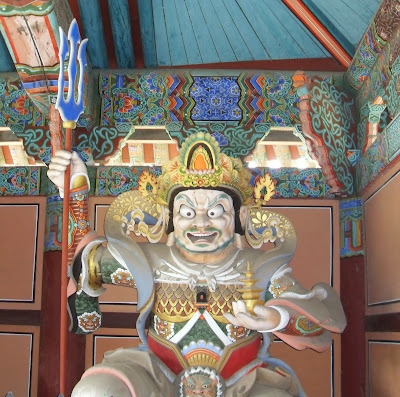


They are all stomping on these gremlins which I suppose would symbolize the opposing notions of greed, violence and suffering among others, perhaps.

This is one of the lager temple complexes in the area, with over a dozen seperate buildings, all of which have specific purposes.


All of the exterior woodwork of the temple buildings are painted in remarkable detail. I found the work on the beams and rafters of the bell house to be truly exceptional.


 Within a park in the city of Hwaseong, about a ten minute train ride and 40 min walk from my place, lay Crown Prince Sado (the father of Jeongjo) and Princess Hyegyeong (posthumously named Emperor Sangjo and Empress Heongyeong), and King Jeongjo and Queen Hyoui. There is a very sad story as to why the son King went to such great lengths to pay tribute to his deceased father. It seems that the good intentions of the crown prince were subverted by a power hungry consort to the reigning king. In seeking to have her progeny raised to the throne she had to get rid of Prince Sado, and so with the help of other court officials had him accused of treason. Now, the current king thought of Prince Sado as a friend and trusted advisor, but in the face of stiff political opposition, and an emotional ploy, he was convinced enough to have prince Sado punished. The choice of punishment was confinement to a rice box. These were wooden chests measuring about 2.5x3x3 feet. In such a confining space, and without any nutrition, Prince Sado died and was buried in the city of Seoul. To the great displeasure of the treacherous consort, Prince Sado's son Jeonjo was crowned the King's successor several years later. In order to exonerate his murdered father, King Jeongjo decided to relocate his tomb to an area south of Seoul, in a grand arrangment. In addition to the physical tomb structure, King Jeongjo made yearly trips to the tomb to pay homage, and we all know that a king does not travel alone. In fact, in order to accomodate these journeys the great fortress of Hwaseong, which I visited the week before, was built to house his 6,000 retainers. And we gripe about the cost of a plane for the president, imagine what would happen if he had to take 6,000 people and a fortress with him, every time he wanted to leave the capital!!!! As his final act of filial piety, King Jeongjo decreed that he would be buried beside his father. Over the past centuries, the tombs have changed location twice and been through numerous renovations, but remain true to the achitecure of the early 18th century, and currently are surrounded by a wooded park in the outskirts of Hwaseong City (about 20 min south of the fortress of the same name).

 After about five solid hours of walking and touring I was ready to sit down and have a hearty meal before the hour long walk back to the metro station. Fortunately, just a block from the tombs are two heavily trafficed korean restaraunts, so I followed a group of folks into one and settled in for an authentic meal. Now although this city is not that far from base, in fact much closer than most places the other Americans visit, it is a little off the beaten path and does not see many non-koreans. To that end, there was a distinct lack of picture menus, which are my best help in ordering. So, feeling confidant in my choice in restaraunt, I courageously took the menu, point to the third thing on the list, and said I will have that please. With a smile and nod, my server dissapered to bring the onipresent kim-chi to tide me over till my meal waqs ready. Well, as it hit the table, it was not all that apparent how much I had erred, as it appeared like many of my other meals; a steaming bowl of hearty broth with vegatables and muchrooms, rice, and a bowl of, of...what is that stuff I am supposed to eat in my soup??? As I pondered the deep purple blobs in the metal bowl, I took a few sips of the broth, and up sprouted an ARTERY! Well, now my brain was racing, and the answers my highly analytic mind were delivering were not at all comforting. What else do I know that has the color of the bobs? Blood sausage and pudding, obviously. What do arteries do? Transmit bllod through the body. What is this soup? Congealed blood and artery soup, you nin-kum-poop! Never on to baulk from a culinary challege, I put on my most gracious face for my doting hosts, plopped the blood in the soup and went to task. Aided by a generous addition of chile paste, I managed to chew every rubery bit and bloody bite. In truth the congealed blood had very little flavor and was of a semi-hard texture reminicent of softer aspic jelly, without any chewiness. The artery bitson the other hand were excessively chewy, with a very gamey aftertaste that I did not truly enjoy. Laughing together at my my expense a the counter, I thanked them for my meal and their hospitality, and with a look of true curiousity they asked me literally if it was "deliciousy." Well, I would hate to be called a liar, but I couldn't be the guy to steal the sparkle from their eyes in witnessing some unwitting bloke down such a bizarre meal...so I say yes, emphatically, haha.
 In the future I plan on doing a much more thorough interrogation concerning my meals, but hey, how many people can say they had Congealed Blood and Artery Soup? Hopefully Friday I will get to posting my adventure with my budding new hiking buddy Pae Hyong Chon, one of the librarians on base ;-)
On the long walk to the temple from the metro station, I grabbed a quick bite from a street vendor and found that the Koreans have one-uped us on unhealthy food. They took a perfectly unhealthy all American corn dog, fried it, then covered it in a second layer of batter and fried it again! You got to love ingenuity, haha!!

 The entrance to the Yongju-sa is guarded by simply magnificent wooden statues of the "Four Heavenly Kings." These are about eight feet in height while seated, giving a very imposing impression, while the ferociousness in thier visages made me think twice about taking their picture...but I found the courage in the end. This tidbit of their mythology is humourous, and it makes me wonder what they would have to report in today's climate; "On the 8th, 14th and 15th days of each lunar month, the Four Heavenly Kings either send out messengers or go themselves to see how virtue and morality are faring in the world of men." (from wikipedia). And here they are:
 The North

The South

The East

The West

They are all stomping on these gremlins which I suppose would symbolize the opposing notions of greed, violence and suffering among others, perhaps.

This is one of the lager temple complexes in the area, with over a dozen seperate buildings, all of which have specific purposes.


All of the exterior woodwork of the temple buildings are painted in remarkable detail. I found the work on the beams and rafters of the bell house to be truly exceptional.

______________________________________________________

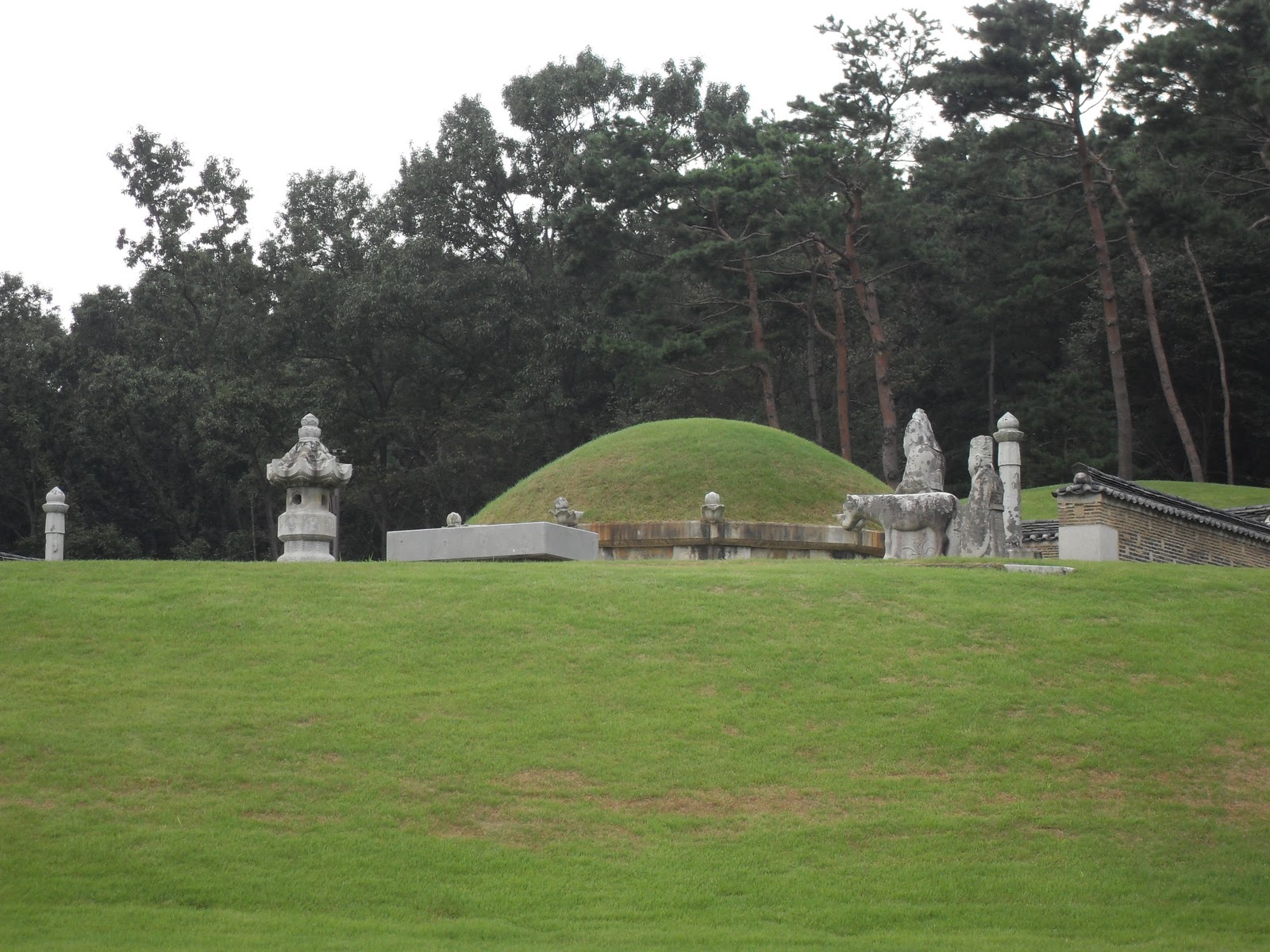 Within a park in the city of Hwaseong, about a ten minute train ride and 40 min walk from my place, lay Crown Prince Sado (the father of Jeongjo) and Princess Hyegyeong (posthumously named Emperor Sangjo and Empress Heongyeong), and King Jeongjo and Queen Hyoui. There is a very sad story as to why the son King went to such great lengths to pay tribute to his deceased father. It seems that the good intentions of the crown prince were subverted by a power hungry consort to the reigning king. In seeking to have her progeny raised to the throne she had to get rid of Prince Sado, and so with the help of other court officials had him accused of treason. Now, the current king thought of Prince Sado as a friend and trusted advisor, but in the face of stiff political opposition, and an emotional ploy, he was convinced enough to have prince Sado punished. The choice of punishment was confinement to a rice box. These were wooden chests measuring about 2.5x3x3 feet. In such a confining space, and without any nutrition, Prince Sado died and was buried in the city of Seoul. To the great displeasure of the treacherous consort, Prince Sado's son Jeonjo was crowned the King's successor several years later. In order to exonerate his murdered father, King Jeongjo decided to relocate his tomb to an area south of Seoul, in a grand arrangment. In addition to the physical tomb structure, King Jeongjo made yearly trips to the tomb to pay homage, and we all know that a king does not travel alone. In fact, in order to accomodate these journeys the great fortress of Hwaseong, which I visited the week before, was built to house his 6,000 retainers. And we gripe about the cost of a plane for the president, imagine what would happen if he had to take 6,000 people and a fortress with him, every time he wanted to leave the capital!!!! As his final act of filial piety, King Jeongjo decreed that he would be buried beside his father. Over the past centuries, the tombs have changed location twice and been through numerous renovations, but remain true to the achitecure of the early 18th century, and currently are surrounded by a wooded park in the outskirts of Hwaseong City (about 20 min south of the fortress of the same name).
_______________________________________________________
 After about five solid hours of walking and touring I was ready to sit down and have a hearty meal before the hour long walk back to the metro station. Fortunately, just a block from the tombs are two heavily trafficed korean restaraunts, so I followed a group of folks into one and settled in for an authentic meal. Now although this city is not that far from base, in fact much closer than most places the other Americans visit, it is a little off the beaten path and does not see many non-koreans. To that end, there was a distinct lack of picture menus, which are my best help in ordering. So, feeling confidant in my choice in restaraunt, I courageously took the menu, point to the third thing on the list, and said I will have that please. With a smile and nod, my server dissapered to bring the onipresent kim-chi to tide me over till my meal waqs ready. Well, as it hit the table, it was not all that apparent how much I had erred, as it appeared like many of my other meals; a steaming bowl of hearty broth with vegatables and muchrooms, rice, and a bowl of, of...what is that stuff I am supposed to eat in my soup??? As I pondered the deep purple blobs in the metal bowl, I took a few sips of the broth, and up sprouted an ARTERY! Well, now my brain was racing, and the answers my highly analytic mind were delivering were not at all comforting. What else do I know that has the color of the bobs? Blood sausage and pudding, obviously. What do arteries do? Transmit bllod through the body. What is this soup? Congealed blood and artery soup, you nin-kum-poop! Never on to baulk from a culinary challege, I put on my most gracious face for my doting hosts, plopped the blood in the soup and went to task. Aided by a generous addition of chile paste, I managed to chew every rubery bit and bloody bite. In truth the congealed blood had very little flavor and was of a semi-hard texture reminicent of softer aspic jelly, without any chewiness. The artery bitson the other hand were excessively chewy, with a very gamey aftertaste that I did not truly enjoy. Laughing together at my my expense a the counter, I thanked them for my meal and their hospitality, and with a look of true curiousity they asked me literally if it was "deliciousy." Well, I would hate to be called a liar, but I couldn't be the guy to steal the sparkle from their eyes in witnessing some unwitting bloke down such a bizarre meal...so I say yes, emphatically, haha.
Sunday, September 18, 2011
Bustling Suwon
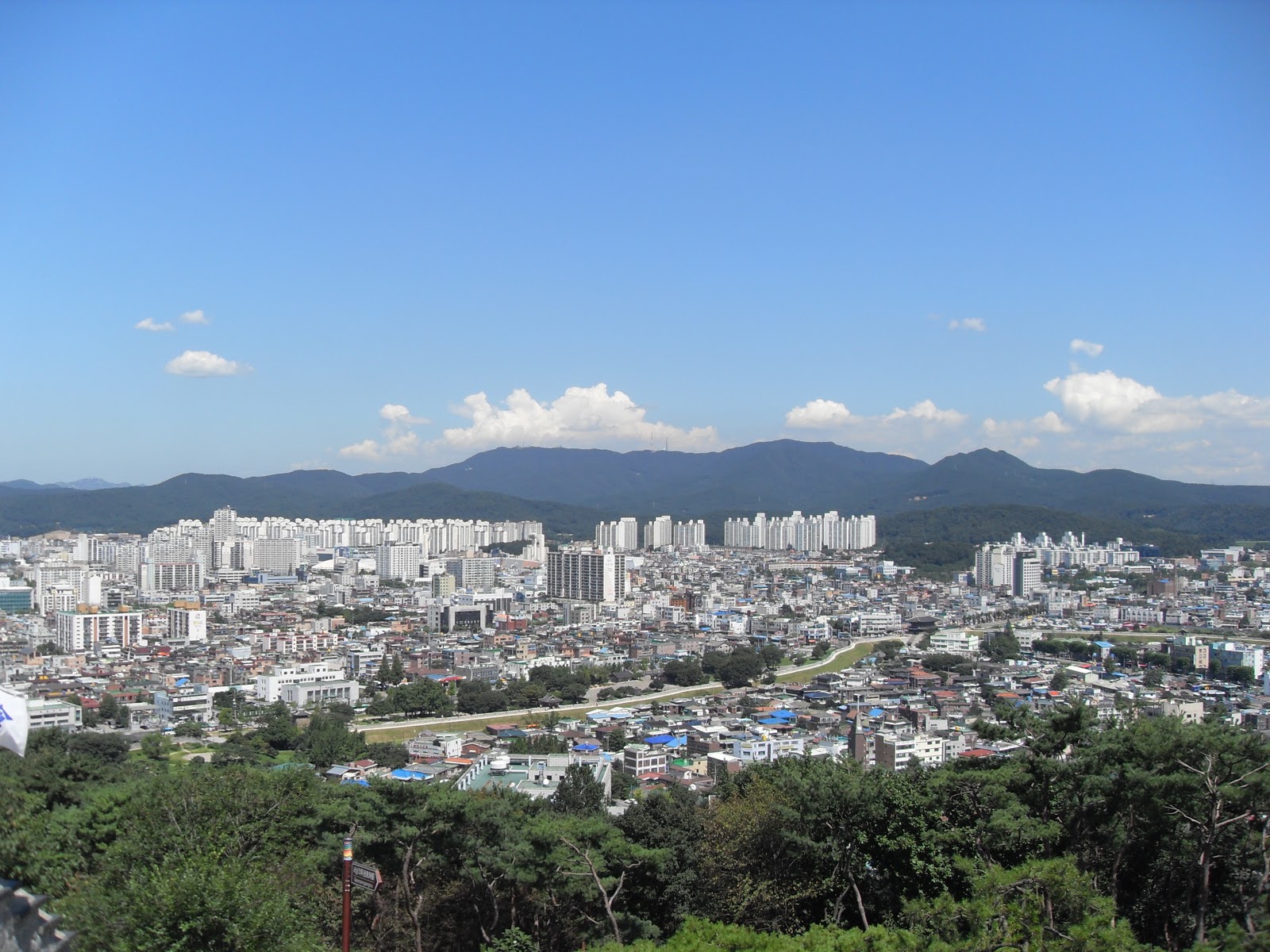
After visiting Burak-san, and getting accustomed to my local stomping grounds, I figured I would take a little trip north for the sights in Suwon. The view as you step outside the metro station:


 A city of 1.2 million in an area less than half the size of Denver, Suwon is quite the busy little metropolis. The biggest attraction here is the well preserved Hwaseong fortress. It covers the high ground in the center of the city and provides fantastic views of the region and a link to the fortress building past of the Joseon Dynasty. The outer wall of the fortress is more that four miles in circumference, which makes for a great hiking tour. Because all of the land inside the fortress that was not part of the preservation project, this fortress reminded me of a German city that still had its wall preserved, like a jam packed city within a city. It took me several hours to tour the outer wall, stopping frequently for pictures. For all of its many remarkable attributes, it has been designated a UNESCO World Heritage site.


Just outside the museum, there was this memorial. Apparently, there was a tradition for the umbilical cords of the kings to be preserved in monuments such as this...not judging, just a bit strange to my standards.

Just outside the main gate is a SPRAWLING market selling fresh produce, dried chillies, meat, seafood, shoes, clothes, plants, perfume, purses, watches, everything you can possibly imagine, by numerous vendors and all prices negotiable. Tonya would have to be given a homing beacon and wheelbarrow for any visit here, as the maze of merchandise and bargains are unending!

The packaging for this SPAM really spoke to me. It is done with the same reverence that I think Pap-pap and I place on this delicacy :-)

After passing all of the food stalls my mouth had begun to water, so it was time to grab a little meal. I stopped in a tiny Korean restaurant, that seemed authentic and unintimidating. Unfortunately, they did not have a picture menu. As luck would have it, the gentlemen eating at the corner table took a special interest in helping me order. It turned out to be a delicious dumpling soup. Four large vegetable and mushroom filled dumpling in a steaming light broth, accompanied with rice and two types of Kim-chi and a tea pot. To my surprise, what I thought was a small pot of tea was actually some type of warm rice/water mixture of a lightly thickened consistance and neutral taste.

 As I started to dig into the meal, I noticed that the guys in the corner kept glancing at me and smiling and saying hello. I figured they were just interested in talking to an American, so I did the polite thing and smiled back and said hello. Well, I guess I kinda opened up the door at that point, because one gentleman yelled over at me and told me to come to the table....holding a shot glass of sojou (Korean vodka). It should come as no surprise that I could not refuse, and I made my way over and one shot lend to another, and then a few broken sentences later and they were feeding me from their table and I was pouring them drinks from mine. I learned that they were five brothers out for their weekend meal together. I also was introduced to just how incredibly friendly the Korean people are. The chef came out and joined in our conversation, adding his help with translation, because by this point the brothers were very deep into a day of drinking, and language training was out the door. As we wrapped things up, they insisted on paying for my meal, as long as I promised to spread the word on how friendly and hospitable they are...and this recounting is part of keeping that promise. Below is a picture of me with brothers number two and five. Brother five could speak the most English, and brother two was the most interested in figuring out what some crazy American was doing walking around by himself in Suwon.
 After this great experience I made my way through the palace on the fortress grounds, and then on my way back to the Metro, stumbled upon a beautiful temple snuggled up with the bars and stores of the market district.

Fortunately Suwon is only about a 20 min ride from base so I will be back frequently, and next time plan on taking plenty of pictures of the market!

A few views of the region from its highest point.


Just outside the museum, there was this memorial. Apparently, there was a tradition for the umbilical cords of the kings to be preserved in monuments such as this...not judging, just a bit strange to my standards.

Just outside the main gate is a SPRAWLING market selling fresh produce, dried chillies, meat, seafood, shoes, clothes, plants, perfume, purses, watches, everything you can possibly imagine, by numerous vendors and all prices negotiable. Tonya would have to be given a homing beacon and wheelbarrow for any visit here, as the maze of merchandise and bargains are unending!

The packaging for this SPAM really spoke to me. It is done with the same reverence that I think Pap-pap and I place on this delicacy :-)

After passing all of the food stalls my mouth had begun to water, so it was time to grab a little meal. I stopped in a tiny Korean restaurant, that seemed authentic and unintimidating. Unfortunately, they did not have a picture menu. As luck would have it, the gentlemen eating at the corner table took a special interest in helping me order. It turned out to be a delicious dumpling soup. Four large vegetable and mushroom filled dumpling in a steaming light broth, accompanied with rice and two types of Kim-chi and a tea pot. To my surprise, what I thought was a small pot of tea was actually some type of warm rice/water mixture of a lightly thickened consistance and neutral taste.

 As I started to dig into the meal, I noticed that the guys in the corner kept glancing at me and smiling and saying hello. I figured they were just interested in talking to an American, so I did the polite thing and smiled back and said hello. Well, I guess I kinda opened up the door at that point, because one gentleman yelled over at me and told me to come to the table....holding a shot glass of sojou (Korean vodka). It should come as no surprise that I could not refuse, and I made my way over and one shot lend to another, and then a few broken sentences later and they were feeding me from their table and I was pouring them drinks from mine. I learned that they were five brothers out for their weekend meal together. I also was introduced to just how incredibly friendly the Korean people are. The chef came out and joined in our conversation, adding his help with translation, because by this point the brothers were very deep into a day of drinking, and language training was out the door. As we wrapped things up, they insisted on paying for my meal, as long as I promised to spread the word on how friendly and hospitable they are...and this recounting is part of keeping that promise. Below is a picture of me with brothers number two and five. Brother five could speak the most English, and brother two was the most interested in figuring out what some crazy American was doing walking around by himself in Suwon.

Fortunately Suwon is only about a 20 min ride from base so I will be back frequently, and next time plan on taking plenty of pictures of the market!
Sunday, September 11, 2011
Finding a Stomping Ground
To be honest, I was hoping that the base would be in a more mountainous region of the country, but as luck would have it, the Air Force was able to find one of the few spots in Korea without an abundance of craggy peaks. Additionally, Korea does not really build "western" style parks, with bike paths and running paths and such. Instead they go to temples and palaces left by their ancestors to do those kinds of things.

Unfortunately, the area of Songtan is lacking in the important palaces department as well. I guess the Joseon Kings did not find it as appealing as the 7th AF. However, after running into dead end after hiking dead end, I ran across a picture online of a pagoda on one Burak-san (-san in Korean means mountain), from the blog of an Airman that served here, and said that this mountain was only about 2 miles from base.
Well, after frantic searching, and a very pleasant and productive conversation with my Korean librarian Mr. Pae, I was headed off to find this mysteriously difficult to locate mountain. I grabbed a cab to hopefully use his local knowledge, but either my Korean phrase book is not accurate, my pronunciation is terrible, or he just wasn't familiar with the park, because Burak-san signaled very little to him, so I asked for city hall instead, which according to Google maps is somewhat nearby. With a shout and finger pointing, I signaled to the cabby that I had spotted the trail entrance from the road, thanked him and headed off. Now, this is not quite Apex Gulch of Mt. Falcon, but the trails on this mountain are very well maintained, and heavily used. And, despite it being a relatively short mountain, only about 600', there are no switchbacks, which can make for some steep uphill climbs.
 For a Sunday Morning, this place was PACKED. There were hundreds of locals out in their top of the line hiking gear, for a stroll and some exercise. Unlike in America, it seems that the Koreans take full advantage of the amenities the local government provides for outdoor activities. There is an entire one mile stretch of the trail basically lined with different exercise stations, including bench presses and some machine that you stand on and twist side to side. These seemed to be more comical than useful, but it still saw heavy usage. I was a little surprised by all of the stares I kept getting, though. I kept thinking "These people live right next to a big US Air Force Base, I shouldn't be that odd to them.", then I realized that it was not ME, but my legs, my very hairy, very un-Korean legs, catching all the stares LOL!
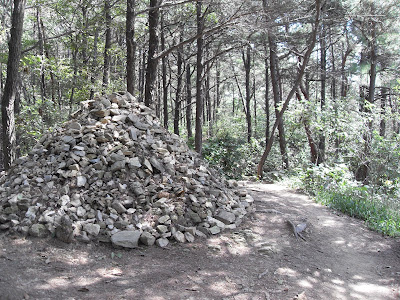
Throughout the trail I kept running into these Cairns. I am not really sure their significance, but they are obviously a living tradition, and can either be stand alone, such as this one, or be at the base of some "significant" tree.
Also, the Koreans traditionally buried the nobles in modes, such as these, and can be found in varying sizes throughout the country. In fact I plan to travel to those of a few kings, as I read that they are great parks and even UNESCO World Heritage Locations.

It is a four mile trek to the summit of Burak-san, and makes for a pretty rewarding 12 mile round trip walk from the gates of the base, there and back again. I am thrilled that I was able to find something like this within easy walking distance of the base. It is a great exercise location, and also a good way to escape from the concrete jungle of the base, and the neon nightmare that is the downtown area just outside the gates (more to come in this phenomenon).

After my hike I stopped in a place recommended by a cabby for lunch. There are basically three internationally famous dishes from Korea: Kim-chi, Bulgogi and Bipimbap. I had a version of Bulgogi (short ribs) here. It was a very good soup of light vegetable broth, cabbage scallions, mushrooms, dumplings seaweed, and the meat of a short rib. I have to say, these string-like white mushrooms have come in just about every soup I've had here, and they add a GREAT texture that is a strange combination of crunchy, squishy and chewy. Also, the dumplings were of rice, in the shape of two small connected mothballs, and were kind of chewy and sticky, mostly tasteless. I quite liked them. The ribs of course were very good, tender and succulent, but not very flavorful. This aspect was added by a green tangy dipping sauce that accompanied the soup.

In addition to every meal, a variety of side dishes are provided. There is always Kim-chi, which I liked in very small quantities, but am not in love with. Of a similar flavor but more interesting texture, were the cubes of radish, that were very crisp and spicy, in the upper right corner. A bit more pungent and less pleasant mouth feel were the dried minnows with peppers, in the center of the table. Lastly, there was a slightly bitter blanched green served plainly with toasted sesame seeds. I enjoyed this, but was not swooning for more. Overall this was a great, filling lunch, and you can't beat the portion or quality for $7.50. I will definitely be back ;-)

Unfortunately, the area of Songtan is lacking in the important palaces department as well. I guess the Joseon Kings did not find it as appealing as the 7th AF. However, after running into dead end after hiking dead end, I ran across a picture online of a pagoda on one Burak-san (-san in Korean means mountain), from the blog of an Airman that served here, and said that this mountain was only about 2 miles from base.
Well, after frantic searching, and a very pleasant and productive conversation with my Korean librarian Mr. Pae, I was headed off to find this mysteriously difficult to locate mountain. I grabbed a cab to hopefully use his local knowledge, but either my Korean phrase book is not accurate, my pronunciation is terrible, or he just wasn't familiar with the park, because Burak-san signaled very little to him, so I asked for city hall instead, which according to Google maps is somewhat nearby. With a shout and finger pointing, I signaled to the cabby that I had spotted the trail entrance from the road, thanked him and headed off. Now, this is not quite Apex Gulch of Mt. Falcon, but the trails on this mountain are very well maintained, and heavily used. And, despite it being a relatively short mountain, only about 600', there are no switchbacks, which can make for some steep uphill climbs.

Throughout the trail I kept running into these Cairns. I am not really sure their significance, but they are obviously a living tradition, and can either be stand alone, such as this one, or be at the base of some "significant" tree.

Also, the Koreans traditionally buried the nobles in modes, such as these, and can be found in varying sizes throughout the country. In fact I plan to travel to those of a few kings, as I read that they are great parks and even UNESCO World Heritage Locations.

It is a four mile trek to the summit of Burak-san, and makes for a pretty rewarding 12 mile round trip walk from the gates of the base, there and back again. I am thrilled that I was able to find something like this within easy walking distance of the base. It is a great exercise location, and also a good way to escape from the concrete jungle of the base, and the neon nightmare that is the downtown area just outside the gates (more to come in this phenomenon).

After my hike I stopped in a place recommended by a cabby for lunch. There are basically three internationally famous dishes from Korea: Kim-chi, Bulgogi and Bipimbap. I had a version of Bulgogi (short ribs) here. It was a very good soup of light vegetable broth, cabbage scallions, mushrooms, dumplings seaweed, and the meat of a short rib. I have to say, these string-like white mushrooms have come in just about every soup I've had here, and they add a GREAT texture that is a strange combination of crunchy, squishy and chewy. Also, the dumplings were of rice, in the shape of two small connected mothballs, and were kind of chewy and sticky, mostly tasteless. I quite liked them. The ribs of course were very good, tender and succulent, but not very flavorful. This aspect was added by a green tangy dipping sauce that accompanied the soup.

In addition to every meal, a variety of side dishes are provided. There is always Kim-chi, which I liked in very small quantities, but am not in love with. Of a similar flavor but more interesting texture, were the cubes of radish, that were very crisp and spicy, in the upper right corner. A bit more pungent and less pleasant mouth feel were the dried minnows with peppers, in the center of the table. Lastly, there was a slightly bitter blanched green served plainly with toasted sesame seeds. I enjoyed this, but was not swooning for more. Overall this was a great, filling lunch, and you can't beat the portion or quality for $7.50. I will definitely be back ;-)
No, Really James?

Well, as you all know I have a distinct penchant for eating. Well, perhaps bordering on obsession with food. I mean, what kind of life can I lead without at least one hearty breakfast, mid-morning snack, lunch, second lunch, mid-afternoon snack, supper, dinner, and bedtime-snack? Now, I know, there are those who may consider this constant consumption of delectable delights a bit of a health problem and, dare I say, a sign of gluttony. However, I have come upon an ancient and fantastic solution to my, debatably unhealthy, taste for copious quantities of butter, cream, and rich (although 100% natural I might add, Mom!!) foods. This solution also happens to be one of my favorite activities, namely hiking. Be it urban exploration in unknown cities and parks, historic locations, or more traditional locales such as mountains and camping trails, an obsessive adherence to "walking" provides my body the activity needed to continue my other passion :-) So, what better way to document my extended tour in the Republic of Korea than by sharing with you the sights of my various meandering hikes, and the local fair that sustained me along the way? Without further introduction, I invite you all to accompany me on my oriental journey upon two sturdy hairy legs and a bottomless iron-kettle stomach.
Subscribe to:
Posts (Atom)